Search

SFX Production Behind-the-Scenes
Gina Piccirilli , 11/19/2025
Prologue
Hello! For a little backstory, I am a 3rd year game design and development major who joined echoes this fall semester (i.e., about 12 weeks ago). This means that I joined towards the very end of the production of the current game set. This had the expected con of having little time to get familiar with the team and the games before working on them and the slightly unexpected pro of having a game aesthetic already defined. This came in handy as someone with a lot of music and audio production experience but with little to no experience in making sound effects, giving me a guideline to follow. For me, the already-developed game was able to inspire the sounds, rather than restrict them.
I want to write about some of my technical work and creative thinking behind the sound effects I made for Jelly Beach, as it can be fun for those who are curious to how the sounds came to be. At the start of this project I was learning a new DAW (Digital Audio Workstation, I used FL Studio producer edition), so a lot of the production involved the very professional art of messing around until something sounded good. But to be honest, even with software I am more familiar with, I can’t say my process isn’t similar. There is one sound effect that has a backstory that you wouldn’t know by hearing it, while others are more straightforward.
Production
I wanted to completely produce and compose as many of the sounds as possible (as opposed to sourcing them), which was easy for sounds like the “item received” and “donut received” jingles. When requesting this sound, my team gave me The Legend of Zelda item jingle as inspiration (which has many variations throughout the game series) and I was able to play around on my keyboard until something stuck. I wish I could be more helpful than that in explaining, but unfortunately there isn’t much of a technical process behind improvising that I can explain. I also made the “failed trade” and “menu button click” sounds myself, which are composed of two sequential notes in the same key as the jingles. The “failed trade” second note goes down, sounding similar to a buzzer and giving the cadence a negative tone, while the notes for the click sound like they go up (see images below). For each effect, I went through and explored plugins that were included in the DAW (I used mostly Flex) until I found instruments/sounds that matched what was in my head. I wanted these to sound very arcade-y, going along with the pixel art and childlike wonder of the game. One of my main goals was to keep the sounds cohesive, so they brought the game together rather than sounding out of place, which helped guide my choices. There were a few of the sound effects that I sourced and edited, such as the footsteps, making them faster to match the speed of the character animation, or the “inventory moving woosh” sound, which was taken from a sword swiping sound effect and slowed down. I saved the most fun sound effect for last, the one with an actual behind-the-scenes story. While working on audio, I took a break to go downstairs for food and I ran into one of my roommates. Upon telling him about how I needed a stomach growling/hunger sound, he made a weirdly accurate sound with his mouth. I have no idea how he did it and I was shocked by how accurate it sounded. He was unsure if he could recreate it again but eventually I got him to record it for me so I could edit and use it. I can’t say for certain that the recording did it justice, but I’d say it was successful since many people assumed I sourced the sound effect. So now you know, the sound you hear in the game in the intro cutscene comes from my roommate’s mouth.
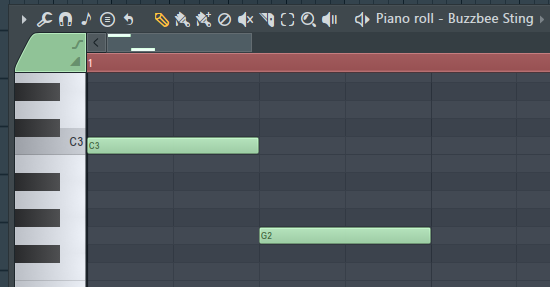
FL Studio screenshot of the “failed trade” sound

FL Studio screenshot of the “menu button click” sound
"Failed Trade"
"Button Click"
I have another story to tell from the process, this one about a challenge faced in production. One thing I thought of from the start was to make sure the sound effects were in a key that wouldn’t clash with the background music, which was made by Ryan Keller (now an alumnus) in a previous semester. The jingle was one of the first sounds I made, and I just made it in the key of C since it was simple and could be easily transposed. When I reached out to Ryan to ask about the key of the music, he told me of a tragedy that had occurred. He told me that he couldn’t access the original files to find out the key, since he had recently woken up to his laptop “drenched in Wendy’s frosty”. Unfortunately, the laptop did not survive, but he was able to give me a general idea of the chords used. The effects in C didn’t aggressively clash with the music, so I kept it.
It felt a bit strange to be wrapping up a game when it felt like I just got there (because I had), but I am very happy that I got to be a part of it and it gave me great sound effect production experience. It is hard to say what my experience would be like if I had joined sooner, if I would be more unsure of what the game needed or if it would be easier. I really do think that having the aesthetic of the game already created was helpful in my learning process, especially in learning new software simultaneously, and I am curious how this experience will help me when producing sfx for new games. One of my favorite parts was being able to hear the sounds make the game come to life, and while joining late, still being able to make an impact on the game.