Search
My echoes Journey
Ayushi Parikh , 04/17/2026
Part 1: The Beginning
echoes is not just a class for me; it’s much more than that. It’s a safe space, a community that lets you experiment and learn in an indie studio setting within a risk-free environment. The echoes concept of making small, personal, community-led, and deeply human games is what pulled me to enroll in this Vertically Integrated Project. I remember Prof. Mesh pitching this idea in our 601 (Game Development Processes) class with the first theme, “Paths of Change – games based on poetry,” and me being sold on the concept immediately. It was a concept that looked at the impact of games on players and transcended the conventional method of learning through books. It highlighted how games can be used to implicitly teach meaningful verses of life without explicitly being marked as a game for change. This is what I am most passionate about in game development: creating games that not only give players a memorable experience but also leave them with meaningful takeaways. Joining the echoes team was, thus, an exhilarating opportunity.
I joined the team as an Associate Producer in the Fall 2026 semester, when the games had already been in development since the previous semester. Along with this, the Associate Producer role was also being introduced in the same semester. Both of these created a great opportunity for me to learn. First, it was being onboarded into games that were nearing completion, and second, it was figuring out my role and how I could support the team better. It was not so much that “whatever the team needed” was my role; it was more about what I wanted to gain, along with where the team needed support. Situations like these teach you how to adapt and pivot yourself to the team’s needs. My tasks included overlooking the production processes of the different teams and engaging in event planning and management. The first few weeks were spent navigating the community and understanding the current production processes. It was like taking a step back and looking at development from a third-person perspective. It made me reflect on how I could apply this to my other projects. The importance of task management boards, code reviews, standups, and meeting notes. These are all basic development practices, but things we often miss while chasing deadlines, especially in student projects. Seeing them from a different perspective really emphasizes how important they are.
I also helped in bits and pieces within the web team, taking up small tasks and relieving some workload from the webmaster (Madison Miller ). It was again that balance of what the team needed and what I also wanted. I had a little bit of web development knowledge, and I could use some of it here. I didn’t have to learn the tech stack from scratch, I could build on my existing knowledge, read the documentation, and help the web team with small updates like formatting updates or deploying WebGL builds on the website. Despite being connected with the project in its last phase, I never felt like I lacked agency or authority over the games. This is where the community aspect of echoes truly stands out, everyone’s feedback and voice is heard, discussed, and worked upon. It makes everyone feel equally connected and invested in the project, rather than alienating newer members from those who have been working on it for a longer time.
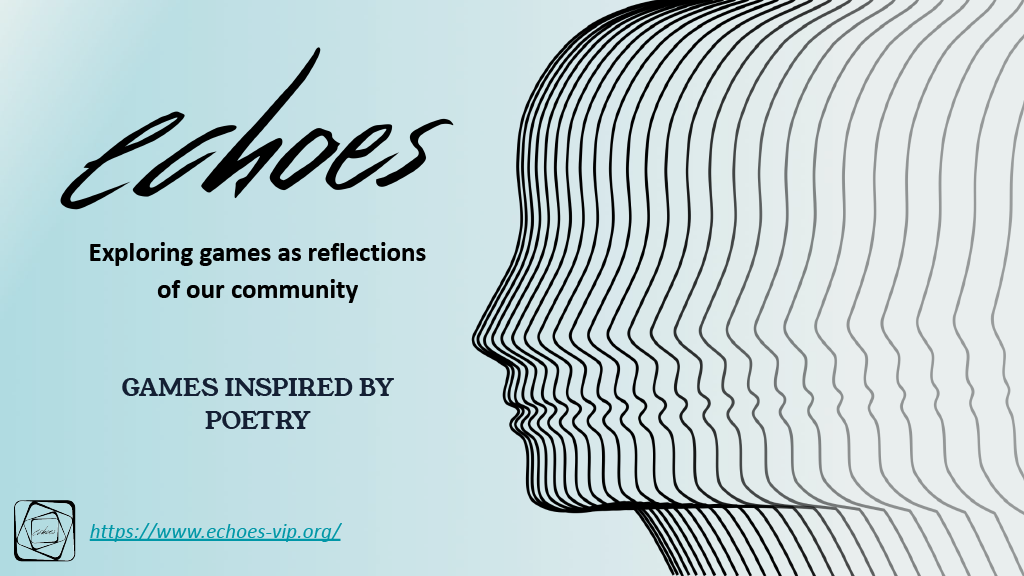
Game Talk 2025 Presentation - Title Slide
I also had the wonderful opportunity to present virtually at Game Talk 2025, held at BJTU - RIT Weihai, RIT Tiger House. It was a platform where I could dive deeper into the concepts of echoes and walk through the meaning attached to each of the four games under the Paths of Change theme. The talk made me look more closely at the design decisions of each game and ask questions like: why was this done, and what impact did it have on the experience? This analysis shed light on a different perspective of the games and revealed a deeper meaning embedded within them. Now, every time I play these games, I’m reminded of that depth.
For example, in Dream Swimmer, the ocean at the bottom of the swimming pool feels endless, but as humans, our reality lies in breathing, we need to be pulled back to the surface in order to dive again. It reflects how nothing in life is permanent, and not everything goes the way we want it to. The core exists in the space between freedom and limitation, control and surrender, and becomes the heart of the experience.
In Jelly Beach, the main goal is to trade items in exchange for money to eat the jelly doughnut. But the depth is shown not only in its lively aesthetic, which resembles the joys of childhood and the ability to find happiness in small pleasures, but also in how the game emphasizes joy that comes from connection and exchange, not just possession.
The plan for this semester was to complete the production of the ongoing games, finish them up by Brick City Weekend, and transition into the next theme, “Resonant Voices”. I was fascinated by the concept of creating games inspired by poetry, it was not just about translating the words of a poem into a game, but about developing the experience from the learnings we received through engaging with the authors and their work. It was about the feeling. This is what we carried into our next theme. Resonant Voices is about leaders who support and advocate for those around them and teach us to do the same. It follows the same philosophy of creating short, personal experiences based on how we felt; experiences that were inspired by conversations with individuals who actively advocate for change. I was responsible for coordinating and organizing interviews with people we wanted to base the next set of games on. It was a gratifying experience for me, ideating a set of interview questions, figuring out the logistics, and being able to communicate and converse with these influential individuals who are patrons of change. Reading through all the interview notes, a common takeaway stood out: no matter how small you may feel or how small you think your contributions are, keep moving forward and don’t give up. Give back to the community, it’s that resonance that drives change.
The last few weeks of the semester were spent ideating and conceptualizing the interview notes into rough game ideas, and selecting the top three from that pool that would move forward for this theme. All the concepts ideated were interesting and offered a fresh take on how we can express the feeling of community and reality. The one that stood out to me the most was Smoke & Mirrors, a game based on the idea of truth versus perspective, what you see is not always the truth. It’s the game I would contribute to as a game director in the upcoming spring semester. Marking the end of my journey as an Associate Producer and stepping into the role of a Game Director, I was excited to see what the future holds.
Part 2: The Next Chapter
Starting the semester with the learnings from the previous one, sitting in on the web team meetings allowed me to observe and understand how the hierarchy system of echoes works and why, even if everyone’s stakes are the same, we still need levels of structure. It also helped me gain a glimpse of how I could better contribute as a Game Director. The structure is primarily for ensuring a smooth flow of communication, so that information is not lost, and to maintain a sense of responsibility for project management purposes.
My early tasks were to fix and schedule meeting times for the team. After pulling up When2Meet, we found that there was no single time where the whole team could meet together. What we initially decided was to set up a structure of two weekly meetings, where half of the team could meet and discuss at a time. We started with this structure, but quickly realized that it was not actually working and that progress was being hindered. It did not make sense to have major design discussions and decisions when most of the artists and game designers were unable to attend. As a result, we shifted our structure. While we retained the two weekly meetings, we added a midweek quick standup to check in, discuss tasks, and prepare for playtests the next day (if any). We then held a longer design meeting after playtests to debrief, discuss design decisions, and do sprint planning for the upcoming weeks. I would also hold a separate meeting with our composer to relay relevant information. This format worked well for the team, with the standups serving as reminder meetings for tasks and helping keep everyone aligned.
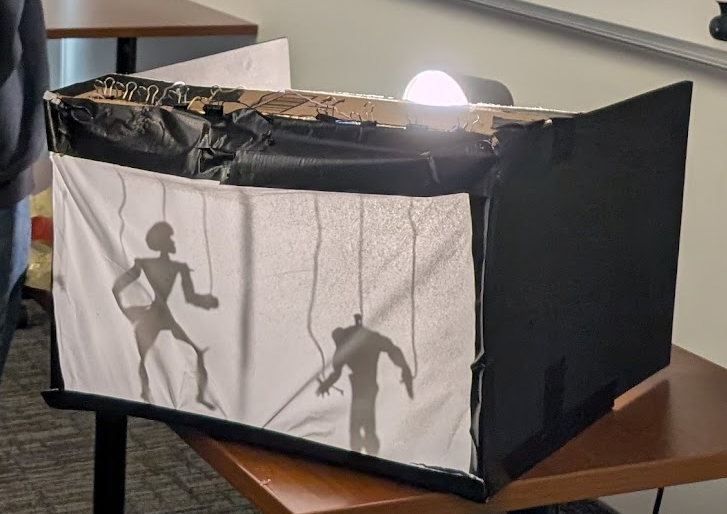
Smoke and Mirrors' Paper Prototype
Once the schedule was set, the next few weeks we spent doing a second round of ideation on the base high concept of Truth VS Perception. The base we were working with was a loose concept of a shadow puppet theatre and a strong message of how the media has an authority to twist and turn the truth and shift people’s perspectives away from the actual truth, what you see is not always the actual truth. Now how do we actually create a game out of this? The aesthetics we have are really solid and new, however just textual decisions of this failed to communicate our intended end goal. One of the early ideas was a puzzle game with 2 perspectives: one behind the theatre where the player interacts with the puppets and one from the audience view of the theatre where players can see the story/perceive the truth. Our team had multiple long discussions, conversing on how exactly we could create gameplay out of this idea, do we have an audience aspect where the NPC audiences rate the player’s shadow puppet creations, etc. A hurdle here was people were not able to visualize our vision, it was hard to imagine what it meant by shadow puppets behind the scenes and what does it mean by their shadows? There was a lot of verbal discussion and conversation on how to tie the gameplay with the theme and how do we rate art (something to be very careful of)? What we actually needed was to fix on a single concept loosely related to the theme and a physical tangible paper prototype to visualize the cool shadow aesthetic of our game. Making this decision as the director helped the team gain a heightened understanding of the concept and interact in real time with the intended mechanics. Making the paper prototype was the highlight of this semester. It was a fun little arts-and-crafts activity we undertook as a team, with everyone huddled around our DIY puppet theatre made from an Amazon box and translucent paper for the screen, cutting puppet parts, stitching them together using paper fasteners, attaching strings to move them, and voilà, switching on the lamp to unfold the magic. This helped clear a lot of design ambiguities both amongst the team as well as people who we pitched the concept to. This served as a conversation starter and steered design discussion in the intended direction. We realised our game did not actually need to have a defined end goal. There is a universal truth and then there are individual perspectives of truth, each unique and personal. Thus, our game is a shadow puppet theatre sandbox where players manipulate puppets, props, background lighting and focal depth behind the scenes - serving as their interpretation of truth, perspective. By flipping over to the audience’s view, players see the final projection of their creation - the actual truth. We also have a prompt card functionality that gives players some direction on what they could base their creation on, it’s an optional suggestion where the game tries to guide the player’s thoughts.
These were the two biggest bumps throughout the semester. Once they were navigated, it was smooth sailing from there. One thing that really helped me orient myself as a Game Director was creating a rough schedule for the entire semester at the start, along with formulating a project backlog with the team. This made it easier to quickly assign tasks during sprint planning and to organize them into major milestone deadlines. Being prepared with each meeting’s agenda beforehand was also something that helped me conduct meetings more effectively throughout the semester. Instead of having the whole team stare at you, wondering what to talk about next, having a clear list helped guide the conversation in the right direction and ensured that important points were discussed rather than getting lost.
My plan this semester was to guide the project’s growth in a direction that would establish a strong base prototype and leave the game in a state that makes it easy and seamless for the next team to pick up and build upon. I believe my team and I have achieved this, and I am happy with the current progress. This semester has been a delightful and memorable experience, and I am looking forward to seeing the complete version of Smoke & Mirrors.